정형 데이터 마이닝 - 타이타닉
library(dplyr)


setwd("C:/ADP/data")

# 데이터 불러오기

titanic <- read.csv("titanic.csv")
summary(titanic)

# cabin, embarked의 "" -> NA 바꾸기

# embarked

# factor 형태로 변환
titanic$embarked <- as.factor(titanic$embarked)

levels(titanic$embarked)
# [1] ""  "C" "Q" "S"

# "" -> NA 변환
levels(titanic$embarked)[1] <- NA

table(titanic$embarked,useNA = "always")
# C    Q    S <NA>
#   270  123  914    2

# cabin

titanic$cabin <- ifelse(titanic$cabin=="",NA,titanic$cabin)
table(titanic$cabin,useNA = "always")


summary(titanic)


# pclass         survived         name               sex                 age
# Min.   :1.000   Min.   :0.000   Length:1309        Length:1309        Min.   : 0.17
# 1st Qu.:2.000   1st Qu.:0.000   Class :character   Class :character   1st Qu.:21.00
# Median :3.000   Median :0.000   Mode  :character   Mode  :character   Median :28.00
# Mean   :2.295   Mean   :0.382                                         Mean   :29.88
# 3rd Qu.:3.000   3rd Qu.:1.000                                         3rd Qu.:39.00
# Max.   :3.000   Max.   :1.000                                         Max.   :80.00
# NA's   :263
#      sibsp            parch          ticket               fare
#  Min.   :0.0000   Min.   :0.000   Length:1309        Min.   :  0.000
#  1st Qu.:0.0000   1st Qu.:0.000   Class :character   1st Qu.:  7.896
#  Median :0.0000   Median :0.000   Mode  :character   Median : 14.454
#  Mean   :0.4989   Mean   :0.385                      Mean   : 33.295
#  3rd Qu.:1.0000   3rd Qu.:0.000                      3rd Qu.: 31.275
#  Max.   :8.0000   Max.   :9.000                      Max.   :512.329
#                                                      NA's   :1
# cabin           embarked
# Length:1309        C   :270
# Class :character   Q   :123
# Mode  :character   S   :914
#                    NA's:  2


# 변수의 데이터 타입 확인 뒤, 타입 변환

str(titanic)

# 'data.frame':	1309 obs. of  11 variables:
#   $ pclass  : int  1 1 1 1 1 1 1 1 1 1 ...
# $ survived: int  1 1 0 0 0 1 1 0 1 0 ...
# $ name    : chr  "Allen, Miss. Elisabeth Walton" "Allison, Master. Hudson Trevor" "Allison, Miss. Helen Loraine" "Allison, Mr. Hudson Joshua Creighton" ...
# $ sex     : chr  "female" "male" "female" "male" ...
# $ age     : num  29 0.92 2 30 25 48 63 39 53 71 ...
# $ sibsp   : int  0 1 1 1 1 0 1 0 2 0 ...
# $ parch   : int  0 2 2 2 2 0 0 0 0 0 ...
# $ ticket  : chr  "24160" "113781" "113781" "113781" ...
# $ fare    : num  211 152 152 152 152 ...
# $ cabin   : chr  "B5" "C22 C26" "C22 C26" "C22 C26" ...
# $ embarked: Factor w/ 3 levels "C","Q","S": 3 3 3 3 3 3 3 3 3 1 ...

# 변수의 데이터 타입 변환
titanic$pclass <- as.factor(titanic$pclass)
titanic$survived <- factor(titanic$survived,levels=c(0,1),labels=c("dead","survived"))

# 변환된 변수 확인
str(titanic)

# 결측치 대치
sum(!complete.cases(titanic))

# 모든 컬럼에 있는 NA 개수를 구해준다.
colSums(is.na(titanic))

# pclass survived     name      sex      age    sibsp    parch   ticket     fare
# 0        0        0        0      263        0        0        0        1
# cabin embarked
# 1014        2


# 수치형 변수 결측치 중앙값 대체
titanic$age[is.na(titanic$age)] <- median(titanic$age, na.rm=TRUE)

sum(is.na(titanic$age))

titanic$fare[is.na(titanic$fare)] <- median(titanic$fare, na.rm = TRUE)

sum(is.na(titanic$fare))


# 변수형 변수 최빈값 대체

# 최빈값 함수

mode <- function(x){
  return(names(sort(table(x), decreasing = T)[1] ) %>% as.character)
}

mode(titanic$embarked)

titanic$embarked[is.na(titanic$embarked)] <- mode(titanic$embarked)

sum(is.na(titanic$embarked))

titanic$cabin[is.na(titanic$cabin)] <- mode(titanic$cabin)

sum(is.na(titanic$cabin))

table(titanic$cabin)


# age의 범주를 나눔

titanic <- within(titanic,
                  {
                    age_band = integer(0)
                    age_band[age>=0 & age<10] = 0
                    age_band[age>=10 & age<20] = 1
                    age_band[age>=20 & age<30] = 2
                    age_band[age>=30 & age<40] = 3
                    age_band[age>=40 & age<50] = 4
                    age_band[age>=50 & age<60] = 5
                    age_band[age>=60 & age<70] = 6
                    age_band[age>=70 & age<80] = 7
                    age_band[age>=80 & age>90] = 8
                  })

titanic$age_band <- factor(titanic$age_band, levels=c(0,1,2,3,4,5,6,7,8),
                           labels=c("10세 미만","10대","20대","30대","40대","50대","60대","70대","80대"))

str(titanic)


# 데이터 분할
set.seed(12345)
idx <- sample(1:nrow(titanic),size=nrow(titanic)*0.7,replace=FALSE)
train_df <-titanic[idx,]
test_df<-titanic[-idx,]
nrow(train_df)
nrow(test_df)


# 모델링 하기 전 분석에 사용할 변수만 추출
train <- train_df[,c("pclass","survived","sex","sibsp","parch","fare","embarked")]
test <- test_df[,c("pclass","survived","sex","sibsp","parch","fare","embarked")]
str(train)

# 모델링 의사결정나무(깊이를 최대 5개까지, 최소 관측치는 15개 이상)
install.packages(c("rpart","rpart.plot"))
library(rpart)
library(rpart.plot)
dt.model <- rpart(survived ~., method='class', data=train, control=rpart.control(maxdepth=4, minsplit=15))
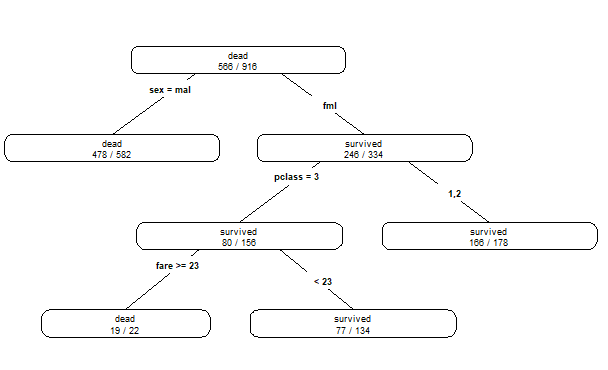
dt.model

# n= 916
#
# node), split, n, loss, yval, (yprob)
# * denotes terminal node
#
# 1) root 916 350 dead (0.61790393 0.38209607)
# 2) sex=male 582 104 dead (0.82130584 0.17869416) *
#   3) sex=female 334  88 survived (0.26347305 0.73652695)
#   6) pclass=3 156  76 survived (0.48717949 0.51282051)
#   12) fare>=23.35 22   3 dead (0.86363636 0.13636364) *
#   13) fare< 23.35 134  57 survived (0.42537313 0.57462687) *
#   7) pclass=1,2 178  12 survived (0.06741573 0.93258427) *

prp(dt.model,type=4,extra=2)
pred <- predict(dt.model,test[,-2],type='prob')
write.csv(pred,"decisionTree predict.csv")

# 모델링 랜덤 포레스트
install.packages("randomForest")
library(randomForest)

rf.model <- randomForest(formula = survived~., data=train)
print(rf.model)

# Call:
#   randomForest(formula = survived ~ ., data = train)
# Type of random forest: classification
# Number of trees: 500
# No. of variables tried at each split: 2
#
# OOB estimate of  error rate: 20.52%
# Confusion matrix:
#   dead survived class.error
# dead      511       55  0.09717314
# survived  133      217  0.38000000

pred <- predict(rf.model,test[,-2],type="prob")
write.csv(pred,"randomForest predict.csv")

# 모델링 로지스틱 회귀분석
lg.model <- step(glm(survived~1, data=train, family="binomial"),direction="both",
                 scope=list(lower=~1, upper=~pclass+sex+sibsp+parch+fare+embarked))

summary(lg.model)


# Call:
#   glm(formula = survived ~ sex + pclass + embarked + sibsp, family = "binomial",
#       data = train)
#
# Deviance Residuals:
#   Min       1Q   Median       3Q      Max
# -2.2973  -0.6783  -0.4402   0.6838   2.3801
#
# Coefficients:
#   Estimate Std. Error z value Pr(>|z|)
# (Intercept)  2.56479    0.26026   9.855  < 2e-16 ***
#   sexmale     -2.68646    0.18501 -14.520  < 2e-16 ***
#   pclass2     -0.61090    0.25349  -2.410  0.01595 *
#   pclass3     -1.54394    0.21864  -7.062 1.64e-12 ***
#   embarkedQ   -0.31418    0.34788  -0.903  0.36646
# embarkedS   -0.61980    0.22001  -2.817  0.00485 **
#   sibsp       -0.16208    0.09883  -1.640  0.10100
# ---
#   Signif. codes:  0 ‘***’ 0.001 ‘**’ 0.01 ‘*’ 0.05 ‘.’ 0.1 ‘ ’ 1
#
# (Dispersion parameter for binomial family taken to be 1)
#
# Null deviance: 1218.43  on 915  degrees of freedom
# Residual deviance:  846.59  on 909  degrees of freedom
# AIC: 860.59
#
# Number of Fisher Scoring iterations: 4

pred <- predict(lg.model, test[,-2], type="response")
pred_df <- as.data.frame(pred)
pred_df$survived <- ifelse(pred_df$pred<=0.5,pred_df$survived<-"dead",pred_df$survived<-"survived")
write.csv(pred_df,"logistic regression predict.csv")

# 성과분석 - 의사결정나무
library(caret)
library(ROCR)
pred.dt<-predict(dt.model,test[,-2],type="class")
confusionMatrix(data=pred.dt, reference=test[,2],positive="survived")

# Confusion Matrix and Statistics
#
# Reference
# Prediction dead survived
# dead      215       57
# survived   28       93
#
# Accuracy : 0.7837
# 95% CI : (0.7397, 0.8234)
# No Information Rate : 0.6183
# P-Value [Acc > NIR] : 1.589e-12
#
# Kappa : 0.5242
#
# Mcnemar's Test P-Value : 0.002389
#
#             Sensitivity : 0.6200
#             Specificity : 0.8848
#          Pos Pred Value : 0.7686
#          Neg Pred Value : 0.7904
#              Prevalence : 0.3817
#          Detection Rate : 0.2366
#    Detection Prevalence : 0.3079
#       Balanced Accuracy : 0.7524
#
#        'Positive' Class : survived
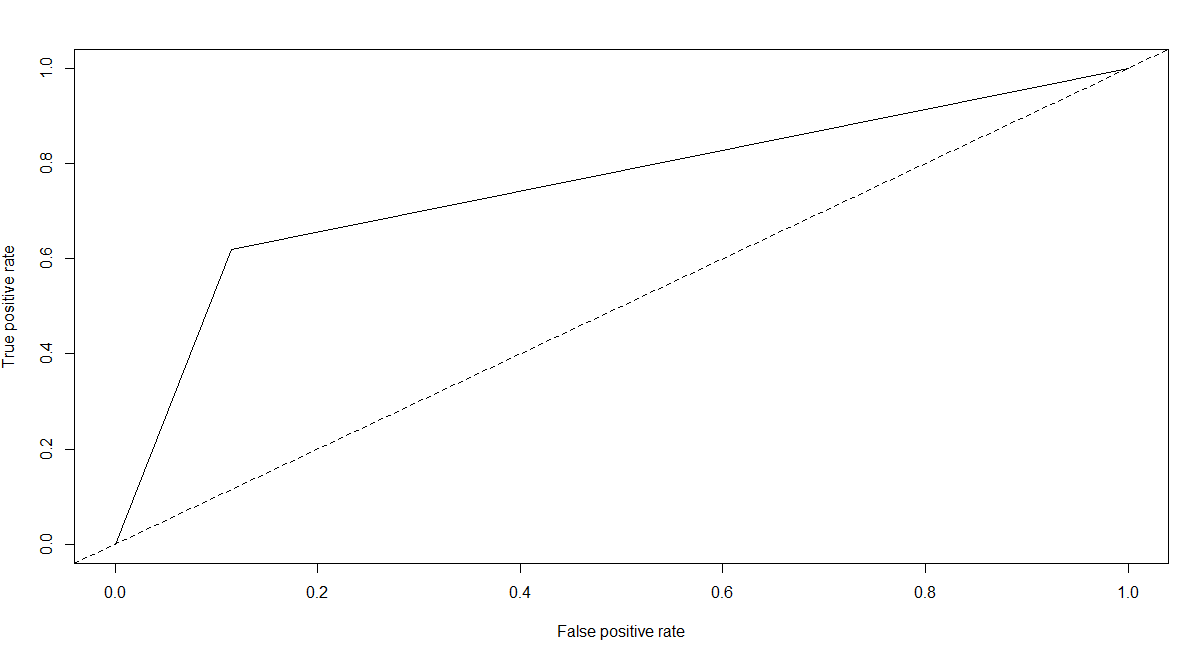
pred.dt.roc <- prediction(as.numeric(pred.dt),as.numeric(test[,2]))
plot(performance(pred.dt.roc,"tpr","fpr"))
abline(a=0,b=1,lty=2,col="black")
performance(pred.dt.roc,"auc")@y.values

# [[1]]
# [1] 0.7523868


# 성과분석 - 랜덤포레스트
pred.rf <- predict(rf.model, test[,-2], type="class")
confusionMatrix(data=pred.rf, reference=test[,2],positive="survived")

# Confusion Matrix and Statistics
#
# Reference
# Prediction dead survived
# dead      219       62
# survived   24       88
#
# Accuracy : 0.7812
# 95% CI : (0.737, 0.8211)
# No Information Rate : 0.6183
# P-Value [Acc > NIR] : 3.555e-12
#
# Kappa : 0.5128
#
# Mcnemar's Test P-Value : 6.613e-05
#
#             Sensitivity : 0.5867
#             Specificity : 0.9012
#          Pos Pred Value : 0.7857
#          Neg Pred Value : 0.7794
#              Prevalence : 0.3817
#          Detection Rate : 0.2239
#    Detection Prevalence : 0.2850
#       Balanced Accuracy : 0.7440
#
#        'Positive' Class : survived

pred.rf.roc <- prediction(as.numeric(pred.rf),as.numeric(test[,2]))
plot(performance(pred.rf.roc,"tpr","fpr"))
abline(a=0,b=1,lty=2,col="black")
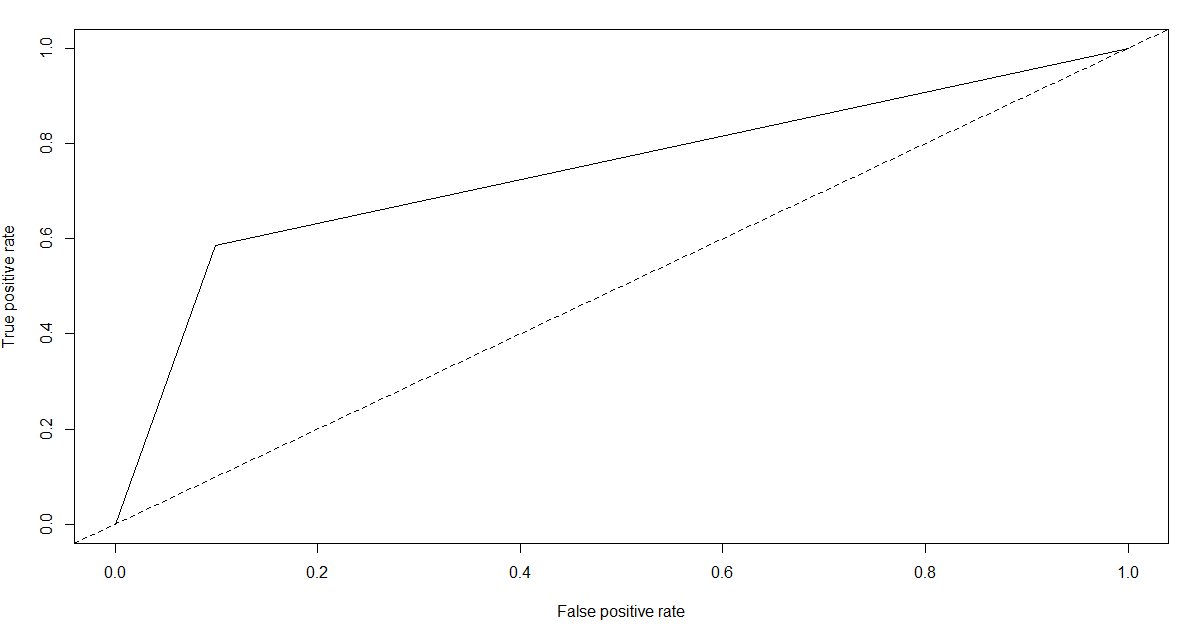
performance(pred.rf.roc,"auc")@y.values

# [[1]]
# [1] 0.7439506

# 성과분석 - 로지스틱 회귀분석

pred.lg <- predict(lg.model,test[,-2],type="response")
pred.lg <- as.data.frame(pred.lg)
pred.lg$survived <- ifelse(pred.lg$pred<=0.5,pred.lg$survived<-"dead",pred.lg$survived<-"survived")
confusionMatrix(data=as.factor(pred.lg$survived),reference=test[,2],positive="survived")

# Confusion Matrix and Statistics
#
# Reference
# Prediction dead survived
# dead      211       57
# survived   32       93
#
# Accuracy : 0.7735
# 95% CI : (0.7289, 0.814)
# No Information Rate : 0.6183
# P-Value [Acc > NIR] : 3.647e-11
#
# Kappa : 0.5044
#
# Mcnemar's Test P-Value : 0.01096
#
#             Sensitivity : 0.6200
#             Specificity : 0.8683
#          Pos Pred Value : 0.7440
#          Neg Pred Value : 0.7873
#              Prevalence : 0.3817
#          Detection Rate : 0.2366
#    Detection Prevalence : 0.3181
#       Balanced Accuracy : 0.7442
#
#        'Positive' Class : survived


pred.lg$survived<-as.factor(pred.lg$survived)
pred.lg.roc<-prediction(as.numeric(pred.lg$survived),as.numeric(test[,2]))
plot(performance(pred.lg.roc,"tpr","fpr"))
abline(a=0,b=1,lty=2,col="black")
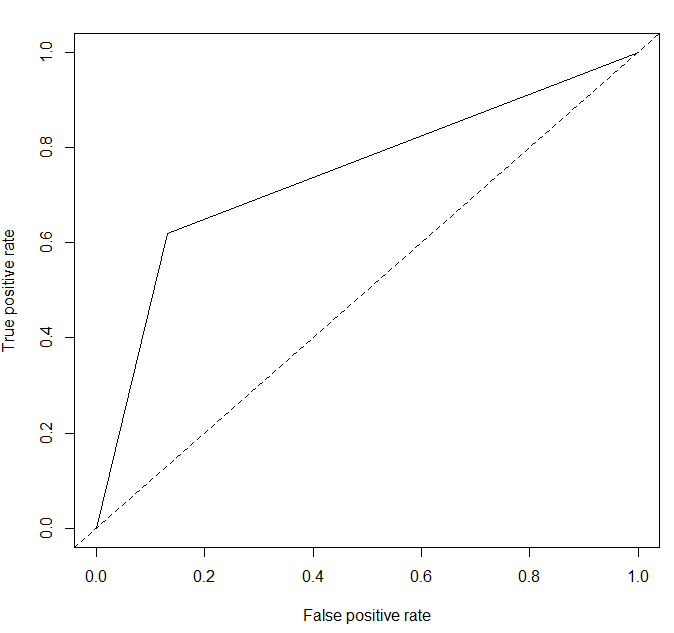
performance(pred.lg.roc,"auc")@y.values


# [[1]]
# [1] 0.7441564